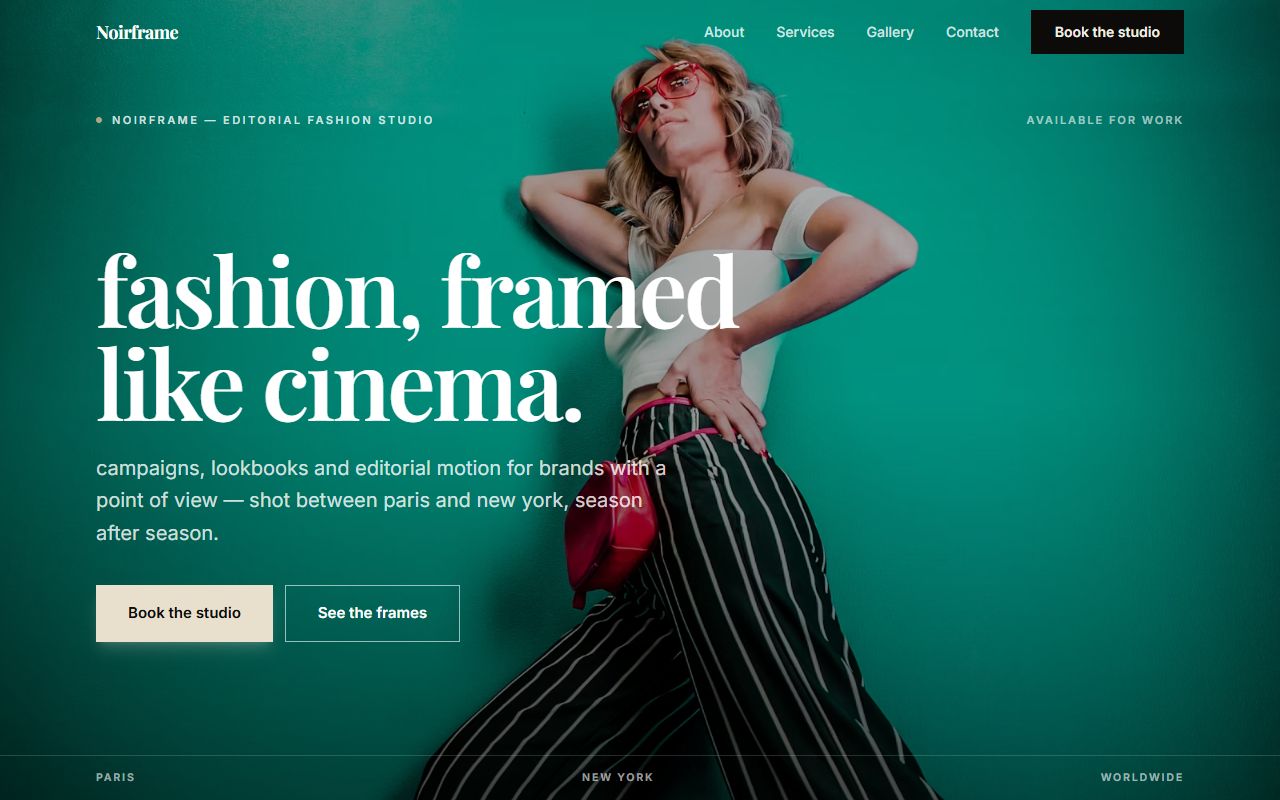
Generate five sites with most AI builders and you get five siblings. Same hero layout, same font pairing, same safe blue. That works right up until the cafe two streets over uses the same tool and ends up with your website wearing a different logo.
SPACEBAR was built to avoid that. The design engine doesn't have a house style it applies to everyone. It has a system for producing looks that are coherent on their own and different from each other, and it keeps a memory of what it has already made so it doesn't repeat itself. Here's how the pieces fit.
Start from a point of view, not a dice roll
Pure randomness produces mush: a serif that fights the buttons, a palette with no opinion. So the engine starts by committing to one of eight named archetypes: Editorial Luxury, Dark Opulent, Warm Artisan, Street-Food Poster, Glassy Modern, Brutalist Café, Playful Pastel, and Minimal Scandinavian.
An archetype is a complete design language, not a color swatch. It decides which font families are allowed to pair, what range of hues the palette can draw from, and how the hero is treated. Everything inside an archetype agrees with everything else, which is exactly the property random generation can't give you.
The archetype isn't picked blind, either. Generation starts from your real business profile, so a late-night cocktail bar and a pediatric dentist land in very different territory before a single color is chosen.
Seeded sampling inside the lines
Within the chosen archetype, the engine samples the specifics from a seed: the heading and body fonts, the exact hues, the hero treatment. Two Warm Artisan sites share a temperament, not a look. One might set a serif over a clay-and-cream palette with a full-bleed photo hero; another lands on different type, a different accent, a different opening.
Because the sampling is seeded rather than free-form, every combination it can produce is one the archetype's rules permit. You get variety without the one-in-ten result where the fonts clash and the buttons vanish into the background.
The engine remembers what it made
Variety within one site isn't enough. The failure mode that matters is two businesses in the same town getting near-identical sites in the same week.
So every generated site stores a design fingerprint: a compact record of the look it was given. When the engine generates a new site, it checks recent fingerprints and steers the sampling away from them. Recently used combinations are off the table, and the new site comes out looking like itself. That's the promise in the title, enforced by bookkeeping rather than luck.
Every palette passes a contrast gate
A generated palette can be striking and still unreadable. That's why every palette the engine produces goes through a hard contrast check: text against its background must meet the WCAG 4.5:1 ratio. If a sampled combination falls short, the colors are adjusted until it passes. No palette ships below the floor, on any archetype, ever.
The gate is one piece of a larger baseline. Published sites target WCAG 2.1 AA: skip links, visible focus rings, alt text threaded through the content model. A site that looks distinctive but can't be read by part of your audience is a bad trade, so the engine is simply not allowed to make it.
Don't like it? Press Regenerate
Taste is taste. If the first result isn't you, the editor has a Regenerate button that re-runs the design pipeline. And it uses the same fingerprint memory: regeneration avoids every look your site has ever had, not just the current one. Press it five times and you see five genuinely different directions, never a shuffle back to attempt number two.
Templates are still a first-class path
Generative design is one door in, not the only one. SPACEBAR also ships a library of hand-tuned templates across verticals, from restaurants and salons to trades and studios. Each one carries structured metadata about the industries it fits, how photo-hungry its layout is, and when to avoid it, so the right starting point is easy to find whether you browse yourself or let the AI pick during generation.
And switching templates later doesn't reset your work. The engine reads your current page back into structured content, pours it into the new template's layout, and carries over any sections the new arrangement doesn't include, with your text, prices, and images intact. Sections are styled by the site's theme, so carried blocks adopt the new look automatically. You change the design, not the content.
Your website is often the first thing a customer sees after your storefront. If it's interchangeable with the shop next door, it says nothing about you. The design engine exists so that a one-minute generated site still reads as yours: one of eight deliberate directions, tuned by seed, checked for contrast, and guaranteed not to be a rerun.
See the range for yourself. Browse the templates, or paste your business profile and watch the engine pick a direction of its own.