Every website builder starts you in the same place: a blank canvas and a blinking cursor. For a small business owner, the blank canvas is where the project dies. You know your business inside out. You don't know what a hero section is, and you have a lunch rush in twenty minutes.
SPACEBAR starts from a different observation: you already wrote your website. It's spread across your Google Business Profile, your Facebook Page, and your Instagram. Your photos, your hours, your address, what you sell, and your customers saying nice things about you. Paste a link, and about a minute later you're looking at a finished draft. Here's what happens during that minute.
Paste one link, or all three
You can hand SPACEBAR any combination of an Instagram profile, a Facebook Page, and a Google Business Profile. It scrapes them all in parallel and keeps going even if one source fails. One link is enough. Three is better, because each source is good at something different:
- Google Business has your verified facts: exact address, opening hours, category, and your reviews.
- Facebook usually has your longer descriptions and contact details.
- Instagram has your best photos.
Merging three versions of the truth
Your profiles disagree with each other more than you'd expect. The phone number on Facebook is the old one. The hours in your Instagram bio haven't changed since March. So the merge follows a fixed priority for facts: Google Business wins, then Facebook, then Instagram. If Google says you close at 22:00 and Facebook says 21:00, the site says 22:00.
Photos work differently. Instead of dumping one source's gallery on top of the rest, the merge interleaves photos across your sources, round by round, with duplicates removed. Your Instagram shots and your Google photos both make it into the pool, so the site doesn't end up looking like only one of your profiles.
Your photos get a permanent home
Here's a step most people never think about. The image URLs on social CDNs are signed and they expire. Hotlink a photo straight from Instagram and your website shows a broken image a few weeks later. So during generation, SPACEBAR downloads every usable photo and re-hosts it on its own storage. From that point on, the copies belong to your site. Your social profiles can change, go private, or disappear, and your website keeps its images.
Every re-hosted photo also lands in your site's media library, including the ones the AI chose not to place on the page. If you want that one shot of the counter on your homepage after all, you drag it on. Nothing scraped gets thrown away.
Copy that only says what your customers said
Then the AI writes the words. The rule is strict: copy is grounded in what was actually scraped. Your real category, your real services, and above all your real reviews. The testimonials on the page come only from your 4 and 5 star Google reviews. If there aren't a couple worth quoting, the section stays empty. SPACEBAR never invents a happy customer.
There's one honesty rule baked in on top: the stats section shows Google's totalreview count, not a filtered one. If your site says 212 reviews, that's all 212, including the grumpy ones. The quotes are curated. The number is not.
The same goes for the small text you'd never think to write. Section headings are AI-written too, so a bakery in Lyon doesn't get a stock “Our Services” heading in English. The language is auto-detected from your profiles, right-to-left scripts included, and the whole site is written in it.
Filled into a template, landed in the editor
Finally, the structured content flows into a hand-tuned template, picked to match your business type and the photos you actually have. A photo-heavy layout is a bad choice for a plumber with two pictures; the picker knows that.
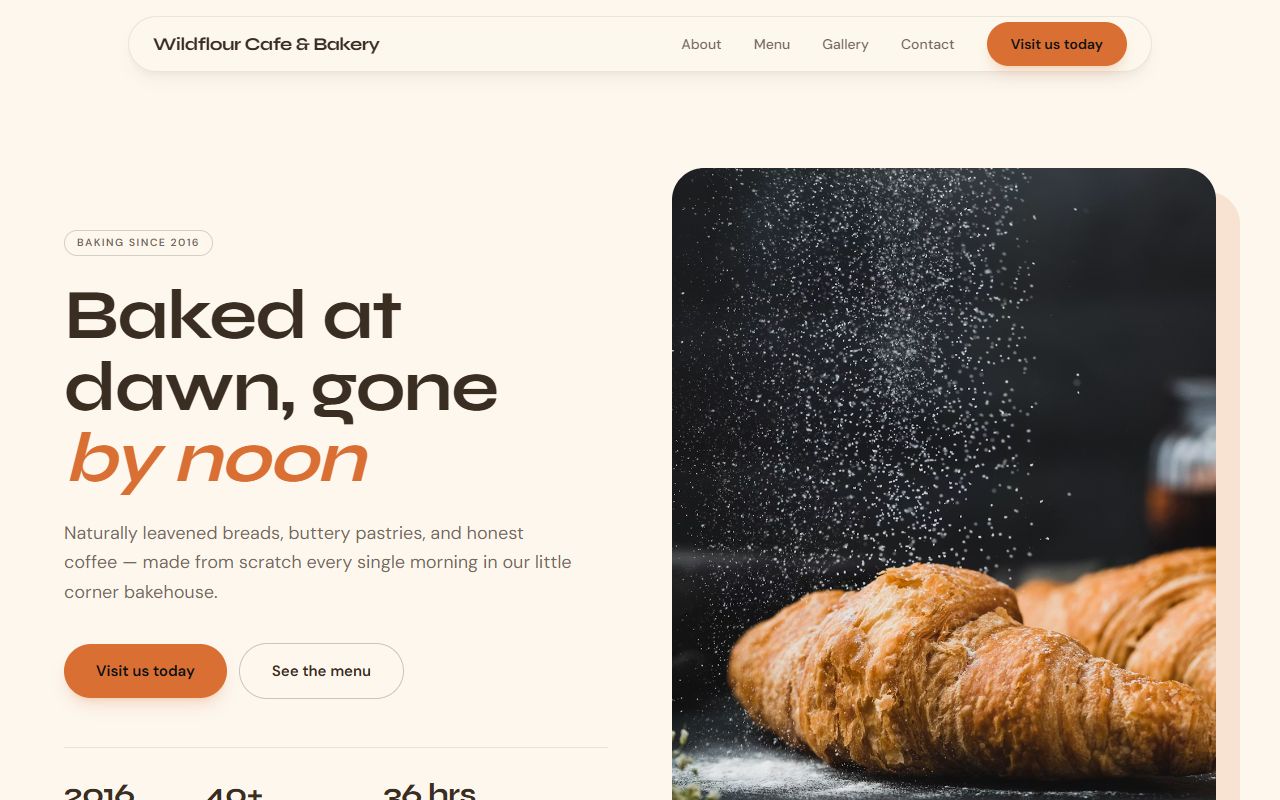
The result lands as a draftin the drag-and-drop editor. Nothing is public yet. What you're looking at is a complete site: a hero with your photo, services with prices, real reviews, a map, hours, a working contact form. And every piece of it is editable. Click a line and rewrite it, drag sections into a different order, swap photos from your library, add blocks from a set of around thirty sections. When it reads right, press publish, and it goes live on your free withspacebar.com subdomain or your own domain.
A draft you react to, not a canvas you fill
The point of the pipeline isn't the minute. It's what the minute produces: a concrete, finished-looking draft you can react to, instead of a blank page you have to fill. Fixing a sentence is easy. Writing a website from nothing is not.
Your profiles have already done the hard part. Start free, paste a link, and see what a minute gets you. Or browse the templates first to see where your content will land.